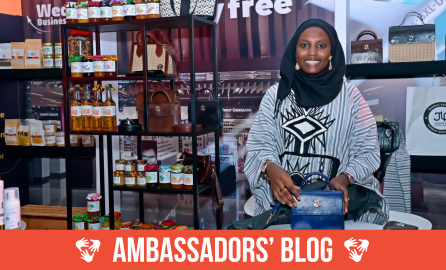
Photo credit: ENABEL. An entrepreneur of the PEM-WECCO cohort displays her merchandise during the closing event in Dakar, September 2024
Migration continues to be a critical issue in global discussions, particularly in the context of humanitarian crises, economic challenges, and social integration. While the narrative surrounding migration often focuses on challenges, a new perspective is emerging that frames migrants and refugees as valuable resources capable of fostering economic and social development.
The positive impact of migration
Migrants and refugees are frequently seen through a lens of vulnerability, yet they represent a reservoir of talent, skills, and experiences. Some of the projects funded by the European Union Emergency Trust Fund for Africa (EUTF) showcase how structured migration policies can yield economic benefits. These have often focused on enhancing employment opportunities, technical skills training, and financial literacy among migrants and refugees. For instance, the programme "Strengthened Socio-Economic Development and Better Employment Opportunities for Refugees and Host Communities" in Ethiopia showcased how Village Savings and Loan Associations (VSLAs) can empower refugees to start their businesses and improve their economic resilience. A shift in perception is crucial to foster understanding of the vital role that migration plays in both the host countries and the migrants’ countries of origin.
One striking example is the Wafira project, which supports women fruit pickers in Morocco to form cooperatives. Jennifer Tangney from the EU Migration Partnership Facility (MPF) noted, “Wafira enables women that participate in seasonal work in Spain to set up businesses back home in Morocco, such as butcher shops and grocery stores, creating sustainable livelihoods.” This initiative not only enhances women's economic independence but also fosters community resilience through cooperative structures.
Furthermore, the PEM WECCO project connected Belgian and Senegalese entrepreneurs to connect business ideas and markets. Tangney highlights: “it’s heartening to see how entrepreneurs can build bridges between countries and people.” Such collaborations illustrate the reciprocal benefits of migration, where both communities gain shared knowledge and economic opportunities.
Migration as a solution to economic instability
The integration of refugees and migrants into labour markets can significantly benefit countries grappling with economic stagnation or demographic decline. At the same time, in the Sahel and Horn of Africa, where conflicts and climate change persist, leveraging the skills of returning migrants can bolster local economies.
Effective integration of refugees and migrants involves promoting not just economic opportunities but also social acceptance and community engagement. Jennifer Tangney remarks on the significance of “establishing ecosystems that build trust,” suggesting that organisational commitment is key to long-term success.
Engagement in local initiatives, such as community workshops or cultural exchanges, can dismantle prejudices and foster understanding. The partnerships formed through projects like Wafira and PEM-WECCO not only support entrepreneurs but also encourage cross-cultural interactions that enrich both communities.
An essential pathway to harness the potential of migration lies in education. Investing in the education of refugee children and tailored training programmes for adults is crucial to foster long-term contributions. Projects that incorporate this focus enable individuals to develop skills that are in demand in local labor markets, benefiting their communities.
Suggested policy recommendations to harness the potential of migration
-
Promote inclusive economic policies: governments should design policies that leverage the skills and potential of refugees and migrants.
-
Encourage public-private partnerships: collaborations between government entities and the private sector can create additional job opportunities for migrants and refugees.
-
Implement gender-sensitive approaches: ensuring women and vulnerable groups are included in economic opportunities is vital to maximising the contributions of diverse community members.
-
Foster community engagement and awareness: initiatives that promote interaction between host populations and refugees help build social cohesion.
-
Invest in education and skill development: ensuring access to quality education for refugee children and training for adults will create pathways for economic integration.
Concluding thoughts
Instead of viewing migrants and refugees solely as challenges, we should recognise their potential as resources that can drive positive social and economic change. By refining policies to harness the skills of these individuals, investing in education, and promoting community engagement, we facilitate their integration in host countries, and also leverage returnees and diaspora for the uplifting of communities in home countries.
A landmark policy guide on entrepreneurship for migrants and refugees developed by UNCTAD, UNHCR, and IOM showed that it is essential that we work together to develop conducive policies that highlight the positive contributions of migrants and refugees. Furthermore, remittances play a crucial role in leveraging investment for sustainable development. In 2025, these financial flows became more important than foreign direct investment and official development assistance together (World Bank, 2025). They not only support families back home but can also foster local entrepreneurship and infrastructure development, adding a layer of resilience to local economies.
As Thor Hezerdahl, a famous Norwegian explorer and anthropologist said, “Borders? I have never seen one, but I heard they exist in the minds of some people.” By dismantling these mental borders and fostering a more integrated understanding of migration, we can create opportunities that uplift not just individuals but entire communities. Through collaborative efforts and innovative projects, we can ensure that migration becomes a source of strength rather than a challenge to overcome.

Log in with your EU Login account to post or comment on the platform.