Increased resource efficiency could help cut global greenhouse gas emissions by 74%, says new study
Discussion details
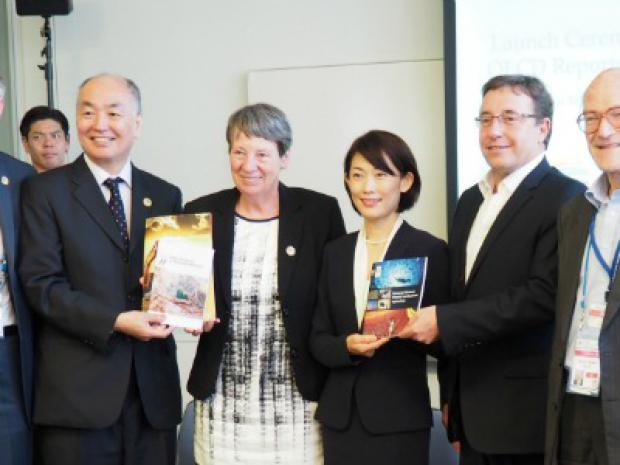
Toyama, Japan, 15 May 2016 - More efficient use of natural resources, together with ambitious global action on climate change, could achieve big cuts in greenhouse gas emissions while at the same time adding to economic growth.
The International Resource Panel, composed of eminent scientists and experts in natural resource management, and hosted by the United Nations Environment Programme (UNEP) since 2007, today released a summary of the findings of its latest report, Resource Efficiency: Potential and Economic Implications, at the G7 Environmental Minister's Meeting in Toyama, Japan. The full report will be released later this year.
The report, based on new modelling carried out for the IRP by Australia's Commonwealth Scientific and Industrial Research Organization (CSIRO) and Austria's International Institute for Applied Systems Analysis (IIASA), projects that under existing trends - increasing population, urbanization, and an expanding global middle-class - natural resource extraction will increase from 85 to 186 billion tonnes over the next 35 years. However, it suggests that effective resource efficiency policies and ambitious global action on climate change could:
- reduce global resource extraction by up to 28 per cent by 2050, compared to a reference scenario based on existing trends;
- cut global greenhouse gas emissions by 74 per cent by 2050 relative to 2015 levels, and;
- increase economic output (GDP) by 1 per cent in G7 countries and globally.
The report also finds that the 1 per cent potential increase in GDP is at the low end of results from a compendium of other studies on increased resource efficiency, using different kinds of macroeconomic models. This evidence suggests that addressing issues of climate change mitigation and efficient use of natural resources together can generate increased economic output and employment while meeting the climate targets in the Paris Agreement and the SDGs.
UNEP Executive Director Achim Steiner joined UNEP International Resource Panel's Co-Chair, Janez Potočnik and lead report author Paul Ekin in presenting the summary report to G7 Environment Ministers, represented by Japan's Environment Minister, Tamayo Marukawa, and Germany's Environment Minister, Barbara Hendricks.
Less than a year ago, at the G7 Summit in Germany, the leaders of the seven largest economies expressed a commitment to promoting resource efficiency as a key element of sustainable development, and asked the IRP to prepare this report on the potential and promise of resource efficiency. The report demonstrates that while it is significant for the G7 to champion resource efficiency, that alone will not be sufficient; global cooperation will be crucial to realizing climate change and sustainability targets.
To download a copy of the summary report, please visit: http://www.unep.org/resourcepanel/
Read the final communique of the G7 Environment Ministers meeting here.
The IRP report was released alongside the OECD's Policy Guidance on Resource Efficiency, which says advanced economies have room to do much more to design and produce goods in a way that uses fewer natural resources and produces less waste.
The OECD report can be found here.
Log in with your EU Login account to post or comment on the platform.