Democracy Support in an Age of Geopolitical Pressure: Reflections from the Launch of the European Democracy Support Annual Review 2025
News details
At a moment of growing geopolitical uncertainty, shrinking democratic space and increasing pressure on international support structures, the launch of the European Democracy Support Annual Review 2025 offered a timely opportunity to reflect on where democracy support stands today, and where it may be heading next.
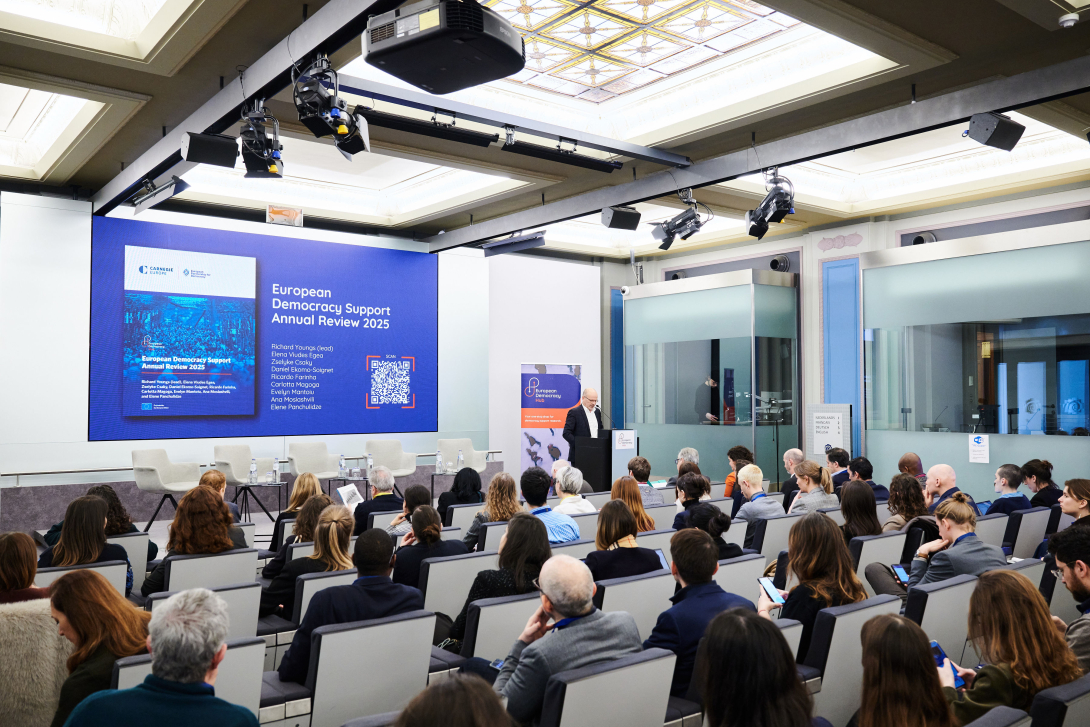
The event brought together policymakers, researchers, practitioners and democracy actors from across Europe and beyond. The discussion was a valuable opportunity to further reflect on a rapidly changing environment for democracy support and to gather insights from a range of perspectives on how the European Union and its partners can respond.
The discussions made one point clear: democracy support can no longer be treated as a secondary or purely normative agenda. It is increasingly tied to questions of security, resilience, international partnerships and Europe’s broader role in the world.
A MORE DIFFICULT ENVIRONMENT FOR DEMOCRACY SUPPORT
A central theme throughout the event was the growing strain on the global democracy support architecture. Speakers highlighted how the past year has brought systemic shifts in geopolitics, including the intensification of authoritarian influence, the spread of disinformation and surveillance tools, and growing uncertainty around long-standing international partnerships.
Particular attention was given to the major reduction in US democracy assistance in early 2025. This was described not only as a funding shock, but as a structural disruption to an ecosystem built over decades. Participants underlined that the consequences are being felt across civil society networks, media support structures, election-related work and international partnerships.
This changing context has placed greater attention on Europe’s role. Several speakers argued that the EU is increasingly seen as a predictable and reliable actor, but also stressed that expectations toward Europe are rising accordingly. The question is no longer only whether Europe supports democracy, but how it can do so with sufficient political clarity, speed and strategic coherence.
GEORGIA AS A WARNING SIGN AND A TEST CASE

One of the most notable moments of the event was the intervention by Salome Zourabichvili, the President of Georgia, who offered a stark account of the current situation in her country.
She described Georgia not as a case of gradual democratic backsliding, but as one of accelerating authoritarian consolidation, marked by growing repression, attacks on civil society and media, shrinking space for dissent, and the adoption of laws closely resembling Russian models. Her remarks also underscored that Georgia’s democratic trajectory cannot be separated from its geopolitical significance, particularly in relation to Black Sea security, regional connectivity and the dynamics in the wider South Caucasus.
For many in the room, Georgia emerged as more than a national case. It was framed as a broader test of European credibility. If the EU cannot articulate a stronger and more coherent response in a country that remains deeply pro-European and strategically significant, then questions about the strength of its democracy support commitments will inevitably grow.
The President's intervention was also a reminder that democratic resilience is not an abstract concept. It is lived daily by citizens, activists, journalists and political actors operating under pressure, and it depends not only on financial support, but also on political attention, public solidarity and credible international engagement.
INTERESTS, VALUES AND THE EU'S EXTERNAL ACTION
A recurring debate during the event concerned the relationship between democratic principles and geopolitical interests. Several participants challenged the increasingly common framing of “values versus interests”, arguing instead that democracy support must be understood as part of Europe’s long-term strategic interest.
This point was made particularly clearly in relation to international order, democratic security and the role of authoritarian influence. A more democratic world, speakers argued, is not only normatively desirable; it is also more stable, more predictable and ultimately safer.
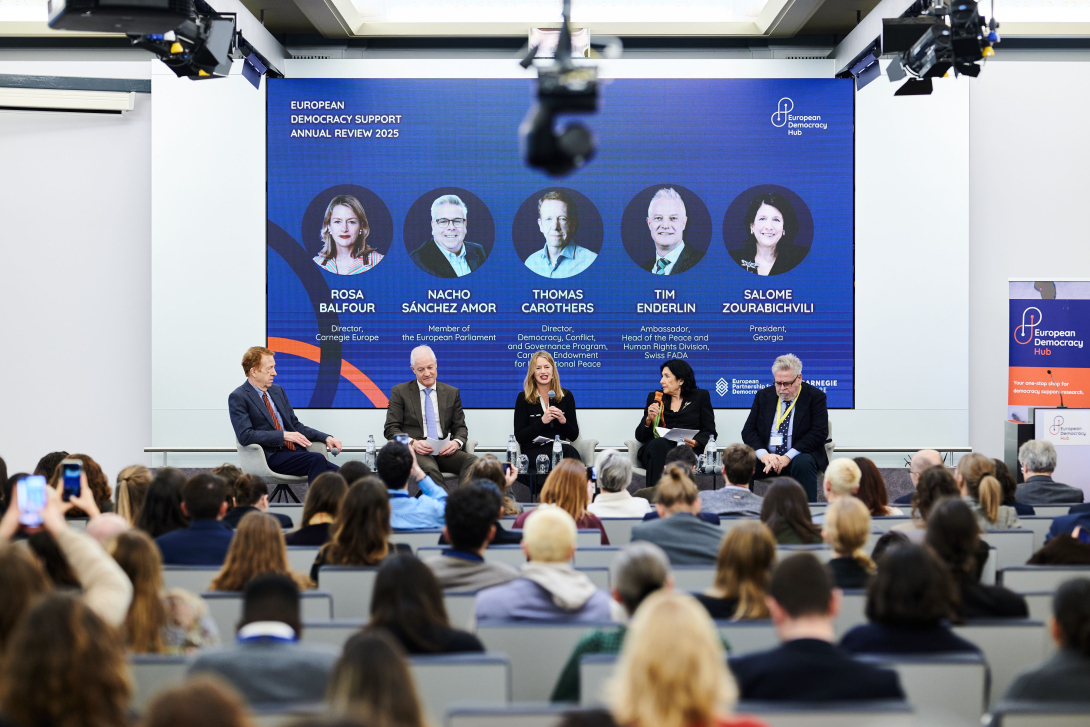
The panel discussions also served as a reminder that democracy and human rights should not be overshadowed by other external action priorities such as energy, trade and migration, particularly in relations with authoritarian and semi-authoritarian governments. This is not a new point in discussions external action, but it resonated strongly in the current context. For the Team Europe Democracy community, this takeaway is highly relevant and shall be further integrated not only rhetorically, but operationally and politically.
THE NEED FOR SHARPER CHOICES AND GREATER ADAPTABILITY
The need for greater strategic prioritisation was also highlighted during the launch. Rather than speaking only in broad terms, participants stressed the need for clearer choices about where and how democracy support can be most effective.
This means, first, identifying and revisit priority countries and contexts where European engagement can make a meaningful difference. Second, it underscores the need for context-driven approaches to democracy support. Supporting democratic actors in a fully authoritarian setting requires different tools and methods than working in a backsliding democracy or in a context of political opening.
Third, it means making hard choices about thematic priorities. Independent media, election integrity, anti-corruption work, civic space and information integrity were all highlighted as areas where gaps are widening and where Europe may need to step up further.
The panel also highlighted the growing importance of flexibility. Some of the most compelling contributions came from actors working directly with protest movements and democratic activists from repressive contexts. Their message was: traditional funding models do not always match the realities of how today’s democratic movements operate. Support must become faster, less prescriptive, more responsive to actual needs on the ground, and more open to new tools and methods.
LISTENING TO MOVEMENTS, NOT ONLY FINDING THEM

The panel on protest movements offered insightful reflections for practitioners. Speakers stressed that many democracy movements today do not fit the mould of traditional civil society organisations. They are often informal, decentralised, transnational and highly adaptive. They may need support for communications, convening, safety, digital infrastructure or emergency resilience more than for classic project structures.
One message was that international actors must begin with a simple question: what do you need? That point resonated strongly because it speaks to an ongoing challenge across the democracy support field. Too often, support is shaped by donor assumptions rather than by movement realities.
Participants also emphasised that support should avoid unnecessary ideological narrowing where it risks fragmenting broad democratic coalitions facing authoritarian rule. At the same time, the discussion reaffirmed that democracy remains grounded in core principles: free and fair elections, rule of law, human rights, pluralism and the ability of citizens to shape and correct their political system.
DEMOCRACY, SECURITY AND DEMOCRATIC SOLIDARITY
A further thread running through the discussions was the relationship between democracy and security. Several speakers argued that these should not be treated as competing agendas. Security institutions that are detached from accountability can undermine democracy, while democracies that fail to respond to security threats may become more vulnerable. The challenge is therefore not to choose between democracy and security, but to ensure that they reinforce one another.
This broader framing matters in the current political context. At a time when public debate is increasingly shaped by war, defence and geopolitical competition, democracy support risks being sidelined unless it is also understood as part of a wider resilience and security agenda.
The launch also repeatedly returned to the idea of democratic solidarity. Whether speaking about Georgia, Venezuela, Iran, Uganda or the Sahel, participants stressed that today’s democratic struggles are interconnected. Authoritarian actors learn from one another, adapt quickly and coordinate across borders. Democratic actors, by contrast, are still too often fragmented.
LOOKING AHEAD
The launch of the European Democracy Support Annual Review 2025 did not offer easy answers, nor did it suggest a single path forward. But it did provide a useful and necessary space for confronting some difficult realities. Europe is operating in a more hostile and contested environment for democracy support. Expectations toward the EU are increasing even as the political and financial environment becomes more difficult. Democratic actors on the ground are asking for more speed, more imagination and more political clarity. And the gap between rhetoric and implementation remains a recurring concern.
The event also showed that there is no shortage of analysis, experience or commitment within the democracy support community. What is needed now is stronger alignment between these assets and a more strategic, politically grounded European response. For the Team Europe Democracy Secretariat, attending the launch was a useful reminder of why platforms for exchange and coordination remain so important. The discussions stressed the need to keep connecting institutions, Member States, civil society and practitioners around practical responses to shared democratic challenges.
Democracy support should not be viewed as peripheral to Europe’s external action. In the current moment, it is increasingly central to questions of resilience, credibility and international partnership. As one closing reflection at the event put it: in 2025, Europe gave itself a democracy shield. The challenge now is to ensure that in 2026 it also shows democratic drive.
Log in with your EU Login account to post or comment on the platform.