Latin America and the Caribbean’s New NDCs Highlight the Need to Translate Climate Commitments into Investment
News details

The new generation of Nationally Determined Contributions (NDCs) in Latin America and the Caribbean reflects important progress in climate planning, transparency and stakeholder participation. At the same time, it points to a persistent gap between climate commitments and their implementation. The 2025 LEDSenLAC Report identifies both the enabling conditions that are already in place and the remaining challenges to translating climate priorities into sustainable investment and economic transformation.
Countries across Latin America and the Caribbean have strengthened their climate policy frameworks through more comprehensive, participatory and technically robust instruments. However, the fifth edition of the LEDSenLAC Report, which analyses the Nationally Determined Contributions (NDCs) of 30 countries, shows that the main challenge is no longer the formulation of commitments, but the creation of the conditions required for their implementation. As of January 2026, 22 countries had submitted updated NDCs and 21 had presented their first Biennial Transparency Reports (BTRs).
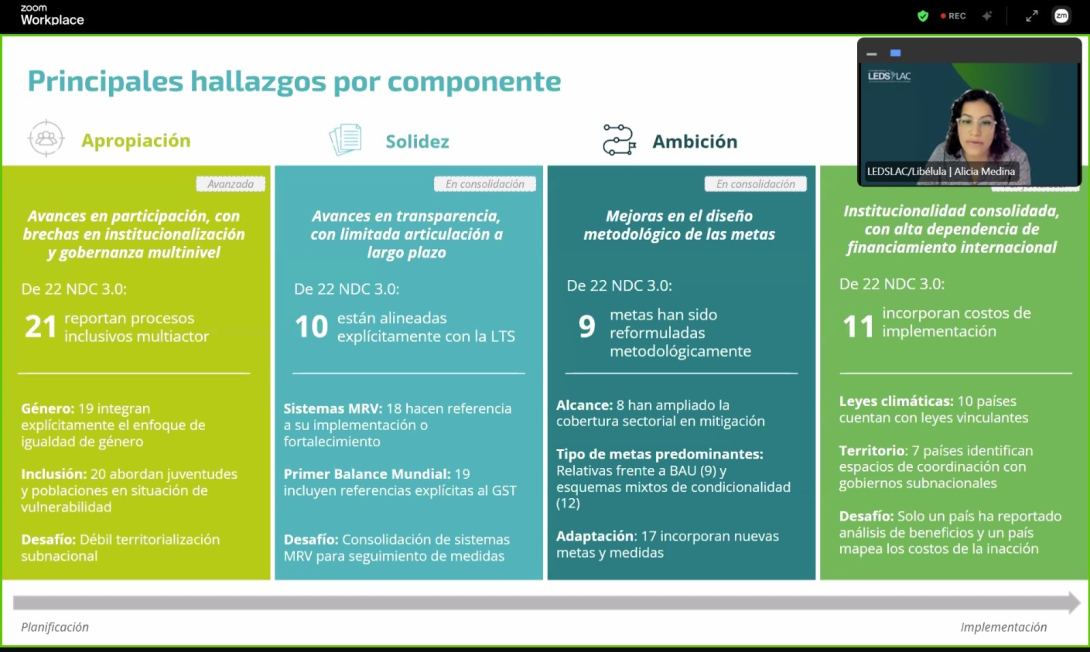
The report finds that one of the most significant challenges is translating climate planning into economic decision-making, financial instruments and investment-ready projects. Only half of the countries analysed have a climate finance strategy, while important gaps remain in areas such as cost estimation, project preparation and alignment with sectoral policies and regulatory frameworks. In this context, NDCs can provide an important framework for guiding public and private investment. However, they are unlikely to fulfil this role unless they are supported by implementation roadmaps, financial instruments and sufficiently developed project pipelines.
The report also identifies examples of progress that illustrate how countries are beginning to address these challenges. Brazil has developed instruments such as the Climate Fund (Fundo Clima) and Eco Invest Brasil to support climate investment. Colombia has integrated the monitoring of greenhouse gas emissions, mitigation and adaptation measures, and climate finance into its National Climate Change Information System. In Peru, the National Registry of Mitigation Actions incorporates both public and private initiatives, while the country continues to advance the development of its climate finance strategy. Mexico, meanwhile, illustrates a situation observed in several countries in the region: although legal and financial instruments are in place, further efforts are needed to strengthen their linkages with NDC implementation.
The experiences analysed suggest that there is no single pathway for mobilising climate investment. Nevertheless, progress requires a combination of national priorities, institutional capacity, regulatory certainty, reliable information and effective project preparation mechanisms. It also requires stronger coordination among public institutions, the private sector and financial actors to ensure that NDCs are integrated into the decisions that shape infrastructure, productive development and territorial planning.

Within the framework of the Global Gateway strategy, these implementation gaps also represent an opportunity for action. Beyond mobilising financial resources, support can contribute to reducing investment risks, strengthening institutional capacities, improving the quality of
investment pipelines and linking climate priorities with broader processes of economic transformation. In this context, the 360-degree approach promoted by Global Gateway provides a useful framework for identifying the enabling conditions that remain to be strengthened and the investments that can generate sustainable and scalable impacts.
The report was prepared through the collaboration of LEDS LAC, IDB, UNDP, ECLAC, and ArticuLAC, an initiative supported by the European Union through the Euroclima Programme and jointly implemented by GIZ, LEDS LAC and INCAE, with additional support from the CABEI. This partnership brings together regional knowledge, international cooperation and financial institutions, reflecting the type of collaboration required to translate increasingly robust climate commitments into effective implementation.
ABOUT EUROCLIMA
Euroclima is a European Union programme that strengthens cooperation between the European Union and Latin America and the Caribbean to support a green and just transition. As part of the Global Gateway strategy, the programme works with 33 partner countries and regional organisations to create enabling conditions for sustainable investment, facilitate access to climate finance and promote knowledge exchange in priority areas such as the energy transition, the bioeconomy, sustainable mobility and water management.
The programme is co-financed by the European Union, the German Federal Government through the Federal Ministry for Economic Cooperation and Development (BMZ), and the Spanish Cooperation. It is implemented in the spirit of Team Europe through the coordinated work of eight partner organisations: the Spanish Agency for International Development Cooperation (AECID), the French Development Agency Group (AFD/Expertise France), the Economic Commission for Latin America and the Caribbean (ECLAC), the International and Ibero-American Foundation for Administration and Public Policies (FIAP), the Deutsche Gesellschaft für Internationale Zusammenarbeit (GIZ) GmbH, the United Nations Environment Programme (UNEP), and the United Nations Development Programme (UNDP).
Log in with your EU Login account to post or comment on the platform.