Predefined indicators
Image
|
|---|
To ensure the highest quality of the EU-funded interventions and their results, DG INTPA’s Unit D.4 (Quality and Results, Evaluation, Knowledge Management) provides step-by-step guidance on Results and Indicators through this Resource. Here, you can find all essential information on methodological approaches, the External Action Services’ Results Frameworks, and concepts, such as corporate/predefined/thematic/customised indicators.
DG INTPA and the European Commission have created methodologies to enhance the capacity of the staff and EU partners around the world. The Intervention Cycle Management Guide (ICM Guide) promotes better use of all guidance, proposes a series of methodological fiches highlighting the main characteristics of each methodology or tool, aligned to each phase of the cycle.
Before delving into the details about the different types of Results Frameworks and Indicators, it is necessary to answer to the following questions:
A results statement is a clear, concise description of the intended outputs, outcomes and impacts of a development intervention. It articulates what the initiative aims to achieve in terms of benefits to the target population or changes in a particular situation, helping to focus efforts and measure success.
These result levels can be represented in a Results Chain and reflected in the structure of the Logical Framework Matrix. A Results Chain is an interactive tool that provides users with a view on the logical links between outputs and outcomes and how their achievement leads to the desired impact.
An Indicator is a variable used to track change, measure results and assess performance, forming the basis of the Intervention’s monitoring and evaluation system.
Indicators can be either quantitative or qualitative variables that provide a simple and reliable means of measuring achievement, reflecting the changes connected to an intervention, or assessing the performance of a development actor.
In OPSYS/EU Funding and Tenders Portal — the European Commission’s IT platform to monitor EU-funded interventions outside the European Union — indicators are added and managed when adding a result to the logframe of an intervention. In the system, indicators fall under two main categories:
- Predefined Indicators, and
- Customised Indicators
To answer the question “Which Indicator to use” the following need to be considered:
- Predefined Indicators were created in OPSYS/EU Funding and Tenders Portal to harmonise and improve the quality of indicators used in the logframes by providing Operational Managers and Implementing Partners with an easily accessible pool of indicators. These indicators are pre-encoded in OPSYS/EU Funding and Tenders Portal and have been formulated to measure the European Union priorities established according to a given financial instrument or to measure policy priorities and commitments of the European Commission not linked to a specific financial instrument. Due to their pre-existence in the system – each predefined indicator has an individual ID in OPSYS/EU FUNDING AND TENDERS PORTAL/EU FTP – all values reported against each specific predefined indicator are aggregated directly in the system. This allows the contributions to the overall EU results made by each individual intervention to be much more visible and boosts the visibility of the implementing partners reporting against predefined indicators. Therefore, the use of one or two predefined indicators per intervention is strongly recommended, starting from the design phase based on their relevance to the intervention. Their use will also strengthen the use of standardised information and thus the harmonization harmonisation between the EU and implementing partners.
- Customised Indicators are designed and created by the Operational Manager and/or Implementing Partners of the intervention. Customised indicators should only be considered if there is no relevant indicator in the list of predefined indicators for the intervention. At the moment of their creation, each customised indicator is assigned a unique ID number. Consequently, the values reported against these customised indicators cannot be aggregated by the system. Even if their description matches that of a predefined indicator, their results will not be aggregated due to the difference in their IDs. This results in no contribution to EU global results and less visibility for the intervention, the EU, and the Implementing Partners. The use of customised indicators is recommended only when none of the existing predefined indicators serve the monitoring purposes of the intervention. Note that FPI does not allow the use of customised indicators.
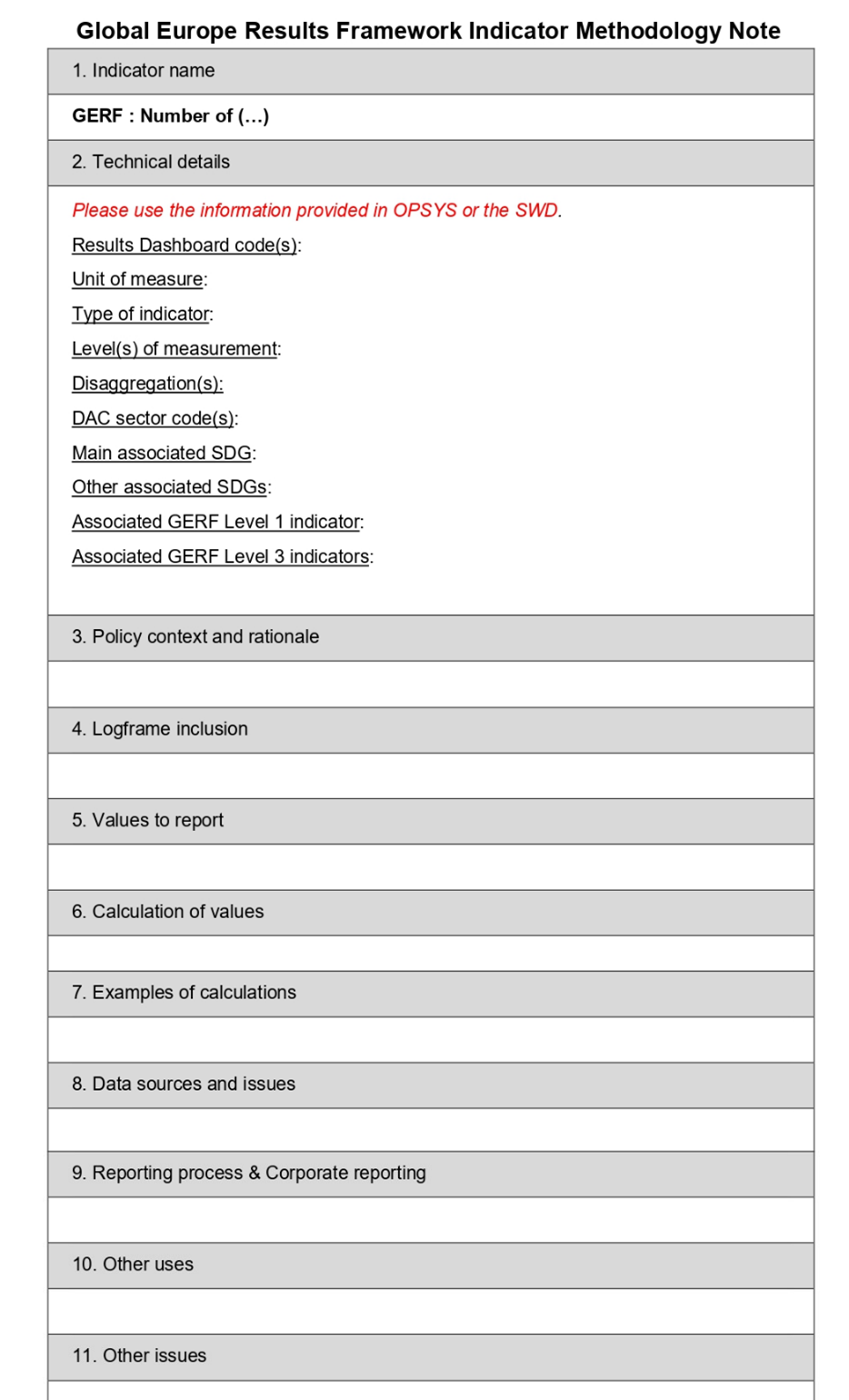
- Methodological Notes are important tools to understand “Which indicator to use” and “If this indicator is suitable for my intervention” during the design phase. Reaching the implementation phase of the intervention cycle and to facilitate the monitoring process, methodological notes are a key resource to better understand if each predefined indicator is a good fit for measuring the result at an outcome level. Methodological notes can be found for each predefined indicator for legal reporting of GERF, IPA III, and FPI. The methodological notes provide essential information about the Predefined Indicators, as those visible in the illustration.

A solid design and monitoring process can be achieved using predefined indicators in OPSYS/EU Funding and Tenders Portal, the values of which can be aggregated (apart from qualitative and percentage-based indicators) and reused in multiple logframes. Through the use of predefined indicators, the results of each intervention can be tracked, the positive aspects highlighted, and weaknesses identified and addressed. The existence of measurable results facilitates better management of interventions and learning through data analysis and is indispensable for accountability and communication purposes. Legal reporting is critical to measure the impact of EU external action in partner countries and ensure accountability for how EU funds are spent. The use of predefined indicators can lead to the continuation or increase of funds in specific sectors or countries, as reporting of aggregated results enables effective annual reporting and presentation of EU External Action results to the EU Parliament, influencing funding decisions.
The use of customised indicators results in values not being aggregated (they bear a separate ID), making the results less visible.