Description
Background
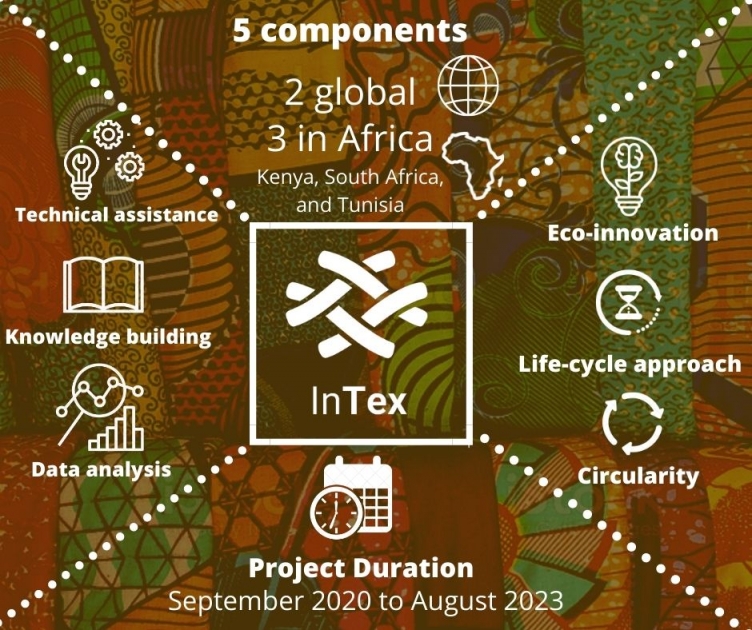
The UN Environment Programme (UNEP) is implementing a three-year project funded by the European Union (EU): Innovative Business Practices and Economic Models in the Textile Value Chain (InTex). The project has five components. Two components have global reach and three components will focus on national implementation in three countries in Africa where textiles is a key economic sector and where companies, including small and medium-sized enterprises (SMEs), are part of multinational value chains (for example exporting towards the European market). Technical intermediaries from three countries (Kenya, South Africa, and Tunisia) are UNEP’s partners implementing the three components that have national focus.
Key objectives
The InTex project aims to
- Increase among SMEs and governments the knowledge on resource efficiency, life cycle thinking, circularity and eco-innovation in the textile value chain
- Train textiles stakeholders on eco-innovation and product environmental footprint (PEF)
- Accompany textiles businesses to transform their approach and business models in order to increase sustainability and circularity in the textile value chain
- Increase the access to environmental and lifecycle data so that textiles businesses and policymakers can make better informed decisions and implement relevant strategies
- Provide evidence of the environmental and socio-economic impacts of the different sustainable economic models in the textiles value chain, to help bridge the science-policy gap and raise awareness on the potential impacts of adopting and fostering innovative sustainable and circular policies and practices
Duration
From September 2020 to August 2023
Next steps
The four technical intermediaries (Moi University in Kenya, the Centre for African Resource Efficiency and Sustainability in South Africa, the National Cleaner Production Centre of South Africa and the International Centre for Environmental Technologies of Tunis,) are working with UNEP to implement the project activities.
Learn more
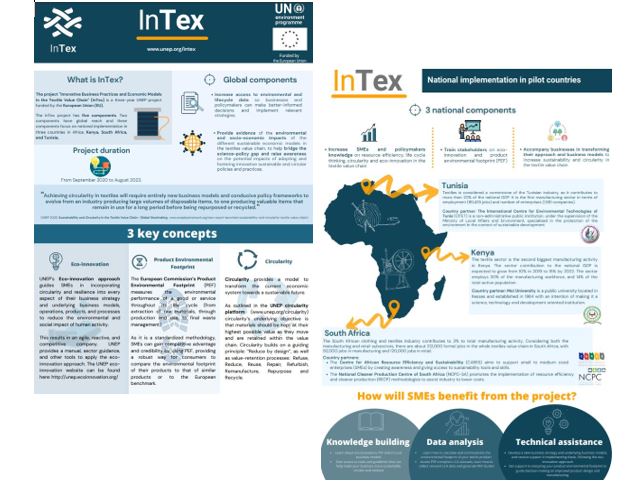
To find more information about the project, please read the brochure here.

Background
The UN Environment Programme (UNEP) is implementing a three-year project funded by the European Union (EU): Innovative Business Practices and Economic Models in the Textile Value Chain (InTex). The project has five components. Two components have global reach and three components will focus on national implementation in three countries in Africa where textiles is a key economic sector and where companies, including small and medium-sized enterprises (SMEs), are part of multinational value chains (for example exporting towards the European market). Technical intermediaries from three countries (Kenya, South Africa, and Tunisia) are UNEP’s partners implementing the three components that have national focus.
Key objectives
The InTex project aims to
- Increase among SMEs and governments the knowledge on resource efficiency, life cycle thinking, circularity and eco-innovation in the textile value chain
- Train textiles stakeholders on eco-innovation and product environmental footprint (PEF)
- Accompany textiles businesses to transform their approach and business models in order to increase sustainability and circularity in the textile value chain
- Increase the access to environmental and lifecycle data so that textiles businesses and policymakers can make better informed decisions and implement relevant strategies
- Provide evidence of the environmental and socio-economic impacts of the different sustainable economic models in the textiles value chain, to help bridge the science-policy gap and raise awareness on the potential impacts of adopting and fostering innovative sustainable and circular policies and practices
Duration
From September 2020 to August 2023
Next steps
The four technical intermediaries (Moi University in Kenya, the Centre for African Resource Efficiency and Sustainability in South Africa, the National Cleaner Production Centre of South Africa and the International Centre for Environmental Technologies of Tunis,) are working with UNEP to implement the project activities.
Learn more
To find more information about the project, please read the brochure here.