Skills and Opportunities in the Private Mining Sector: Meeting the Industry's Need
About Public financial management (PFM) in a fragile context: the case of South Sudan This group explores the lessons-learned from capacity-building on PFM in South Sudan, including findings from the EU Technical Assistance for Sub-national Capacity Building in Payroll and PFM (EUTAPP) as implemented by Ecorys.
Supporting the self-reliance of displacement-affected people.
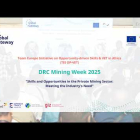
Skills and Opportunities in the Private Mining Sector: Meeting the Industry's Need
Sub-Saharan Africa presents significant investment opportunities across multiple sectors. However, matching these opportunities with the employment aspirations of a fast-growing youth population remains a challenge. Many young people struggle to find decent jobs, while investors face a shortage of relevant skills in the labour force. To help close this gap, the Team Europe Initiative on Opportunity-driven Skills and Vocational Education and Training in Africa (TEI OP-VET) was launched in April 2024 under the Global Gateway strategy. The initiative aims to strengthen vocational education and training systems in SSA by aligning them with concrete employment opportunities emerging from public and private investments, making skills development a core enabler of sustainable growth and job creation.
Milango Housing Projects, Geert De Pauw, and Laura Colini from the UNESCO Chair on Social and Spatial Inclusion of International Migrants. Urban Policies and Practices, University Iuav of Venice, will present a webinar on...
MAPS Project
You can read an article from EUNIC on how the Spaces of Culture initiative that we are supporting in DG INTPA, is reframing the Africa-Europe relations through culture - a second call for proposals will be launched in the spring...
The MAPS Project is a three-year initiative aiming at strengthening policy-making and programming on migration and forced displacement in Sub-Saharan Africa. With a €10 million budget funded primarily by the European Commission, MAPS brings together a multidisciplinary network of African and European partners—including Sapienza University of Rome, five Italian universities with UNESCO Chairs, and universities in Tanzania, Uganda, Kenya, and Spain. It is supported by advisory bodies such as the IOM Regional Data Hub and the University of the Witwatersrand.